
Brain fog has a name now.
For 30 years women said "I have brain fog" and doctors said "you're stressed, drink more water." The 2023-2025 neuroscience literature is finally catching up to what women have been describing.
Pauline Maki at U of Illinois and Victor Henderson at Stanford are the two researchers who have moved this conversation. Mosconi and colleagues documented this in detail, mapping measurable changes in brain glucose metabolism across the menopause transition (Mosconi et al., Scientific Reports, 2021).
The reframe: the brain's primary fuel is glucose. Estrogen helps glucose cross the blood-brain barrier and helps neurons use glucose efficiently. When estrogen drops, glucose uptake in the brain drops — measurable on PET scans as up to 25% reduction in regions including the prefrontal cortex (executive function), hippocampus (memory), and cingulate (attention).
The brain doesn't just sit there with less fuel. It tries to switch to its backup fuel: ketones (fatty acid derivatives). Some women's brains make the switch smoothly. Others get stuck between fuels. That stuck state is brain fog.
This isn't psychological. It's metabolic.
What this means
Three implications:
1. The fog is fixable. Switching the brain to ketones reliably (with diet) or restoring estrogen (with HRT) both help. The data is strongest for HRT initiated within the 10-year window we talked about in letter #1.
2. Cognitive testing in midlife can be misleading. A 52-year-old in the middle of the transition may test 1.5 standard deviations below her actual capacity. Two years post-transition, she's back to baseline. This is why "early Alzheimer's" diagnoses in women 45-58 are sometimes wrong — they're transition states, not disease states.
3. The brain fog is a window, not a sentence. Women who transition well — meaning their brains adapt to the new fuel mix within ~2 years — show no long-term cognitive decline relative to pre-transition baseline (Greendale et al., 2009 — SWAN study). Women who get stuck have worse outcomes, including elevated dementia risk.
The 4-minute morning protocol
Three interventions, every morning, in this order:
Minute 1: Cold exposure. 60 seconds of cold water at the end of the shower. Activates norepinephrine (3x baseline for ~2 hours), which sharpens executive function and crosses the BBB without needing glucose. Šrámek et al., 2000 is the foundational paper; many follow-ups.
Minutes 2-3: 10g protein with healthy fat. Two eggs, or a Greek yogurt with nuts, or a protein shake with MCT. The combination starts the ketone production while giving amino acid substrates for neurotransmitters. Avoid carbs for 2 hours.
Minute 4: 5 minutes outside in direct morning sun. Sets circadian rhythm (which anchors sleep architecture, which anchors deep sleep, which anchors next-day cognition). The light cue is more potent than caffeine for cognitive arousal in the first 4 hours.
That's it. No supplements. No nootropics. The protocol works because each lever targets a different bottleneck in the transition.
Like this letter?
Subscribe to the Sunday letter. One thoughtful read per week, free.
When this doesn't work
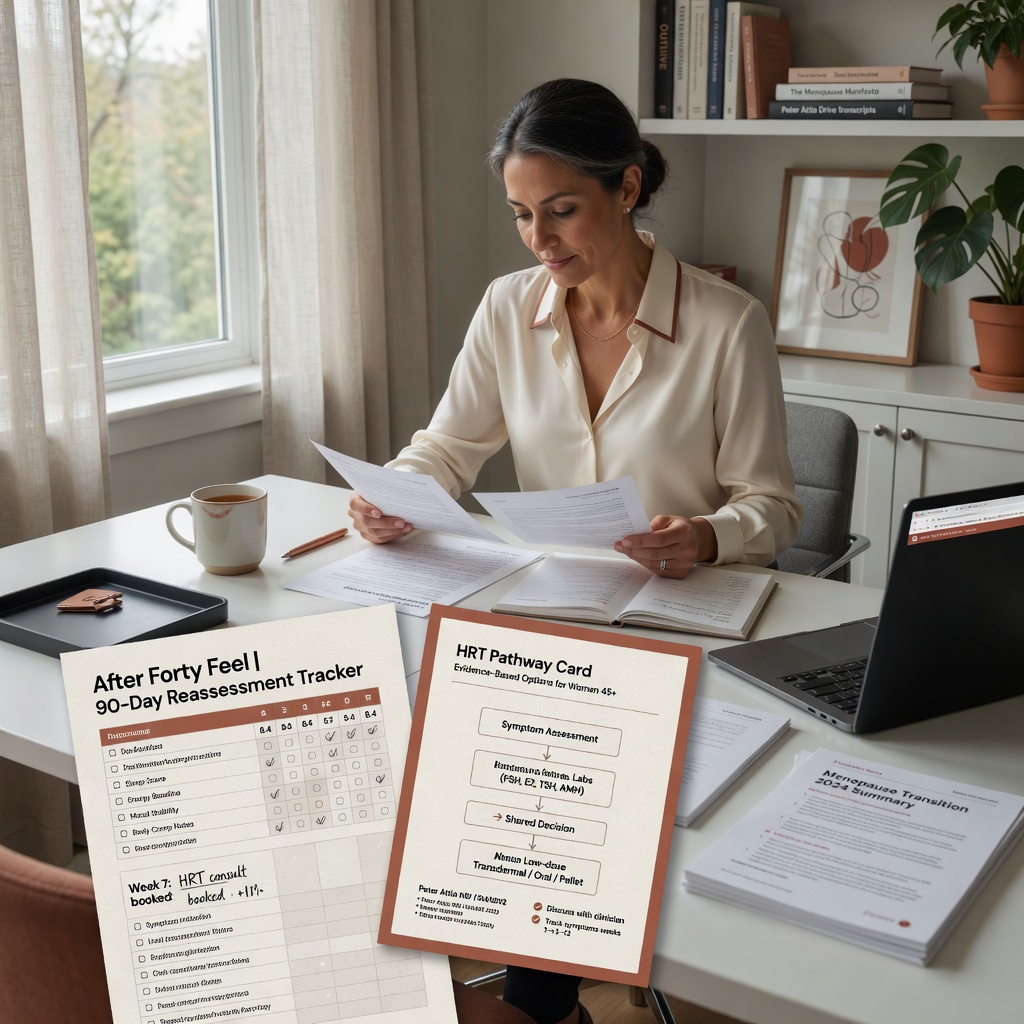
If 4 weeks of the protocol produces no improvement in word-finding, mental math, working memory, and afternoon clarity — the next step is the HRT conversation from letter #1, with the conversation checklist. The neuroenergetic transition can be assisted with estrogen specifically, and the evidence base is strongest at the 47-58 window.
Next week: the money decade. The IRS catch-up window, the Roth conversion year, and the claim-age math nobody runs correctly.
Alexander After Forty Feel Reader-funded. Research-led. No supplement-brand sponsorships.
Get the Sunday letter free.
One long-form research-led piece every Sunday. Reply to anything — Alexander reads every response.
Subscribe →2026 Updates & Context
Key developments since earlier guidance: evolving data on GLP-1 + hormone interactions, refined risk stratification for HRT/TRT, new non-hormonal options, and better tools for body composition tracking. The fundamentals (individualization, resistance training, protein adequacy, sleep) remain the highest-leverage inputs.
Last framework refresh: 2026-06-01
Practical Tools (2026)
- Magnesium glycinate — high-ROI for sleep quality and recovery in midlife.
- Adjustable resistance equipment — for consistent training without gym dependency.
Affiliate disclosure: Links above are Amazon Associates examples. Purchases may earn a commission at no extra cost. We only recommend tools discussed in the research.
2026 Decision Framework
Core questions to answer before acting:
- What is my personal risk/benefit profile based on age, timing, labs, and symptoms?
- Which levers (hormones, training, nutrition, sleep, stress) should I pull first?
- What is my 3-month, 12-month, and 5-year plan for reassessment?
This is synthesis of current evidence — not personalized medical advice.
Launch Campaign Assets (automation)


The Sunday letter
Free. Research-led. One thoughtful letter a week.
Recommended next step
Get personalized clarity or start a pathway
Take the 90-second Hormone Age quiz for your gap analysis, or walk a full decision pathway for HRT, metabolism, TRT, or cognition. Start the quiz · Explore pathways