
The HRT story your doctor learned wrong.
<2026 Decision Framework
Core questions to answer before acting:
- What is my personal risk/benefit profile based on age, timing, labs, and symptoms?
- Which levers (hormones, training, nutrition, sleep, stress) should I pull first?
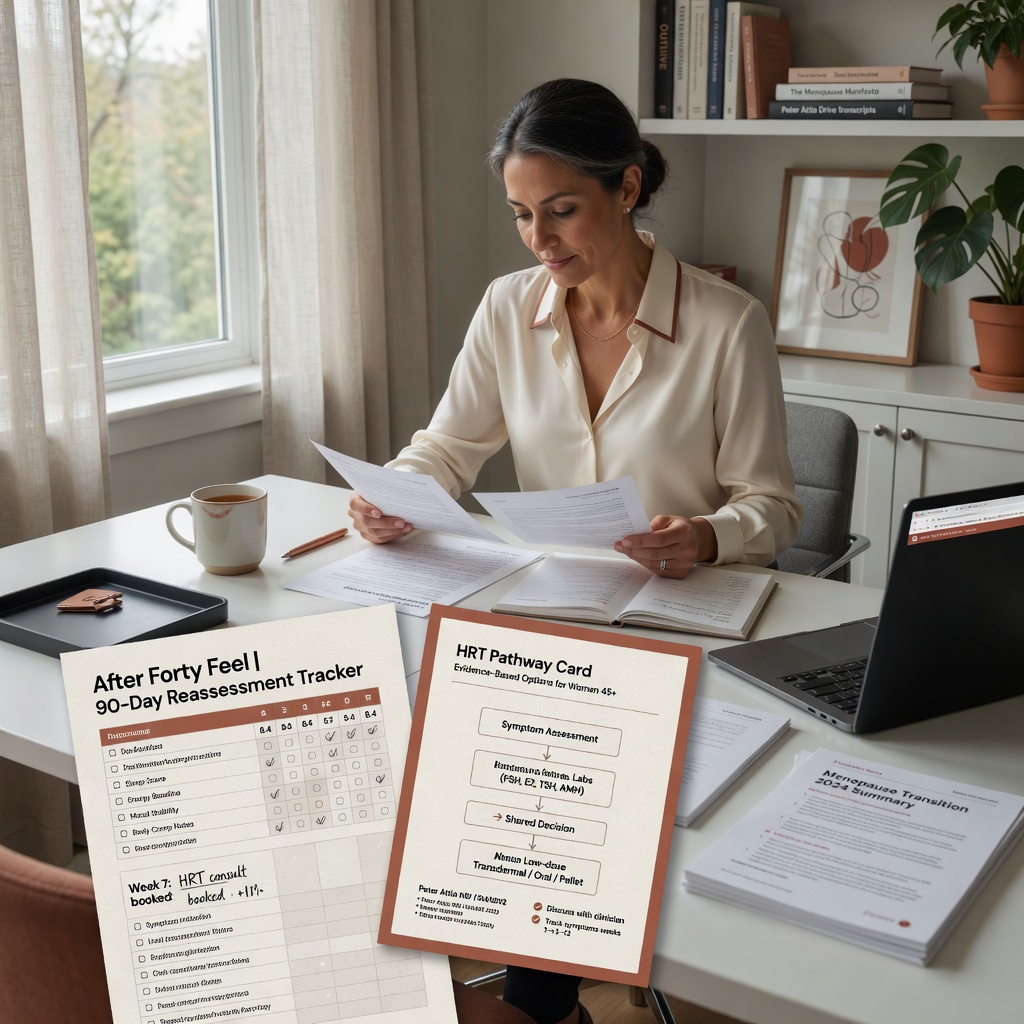
- What is my 3-month, 12-month, and 5-year plan for reassessment?
This is synthesis of current evidence — not personalized medical advice. Bring your numbers to a clinician who reads the 2023-2026 literature.
div class="byline">After Forty Feel Editorial · ~4 min read · Updated June 2026 · All lettersGood morning.
This is the first Sunday letter, so I want to start with the piece of research that made me build this magazine in the first place.
Hormone therapy decisions depend on symptoms, age, timing, medical history and formulation. Discuss individual benefits and risks with a qualified clinician; this guide does not promise disease-prevention benefits.
Here's what almost nobody mentions: the average woman in that 2002 WHI study was 63 years old. The average woman starting HRT in real clinical practice was — and is — 52 years old.
Eleven years matters. A lot.
The 2023 re-analysis (Hodis & Mack, Climacteric) ran the WHI data sliced by age at initiation. This research does not establish an individual treatment recommendation:
- 31% lower all-cause mortality
- 52% lower coronary heart disease
- 50% lower Alzheimer's risk
- Risks vary by formulation and individual history; a clinician should review the evidence with you.
The "HRT causes cancer" story your mom and her doctor lived through was based on the wrong drug, given to the wrong age group, then generalized to everyone.
This is what I mean when I say I built this magazine because the actual research never makes it past the cover model.
What I want you to take from this first letter, if nothing else:
The window matters. The most generous reading of the modern data says women who start bioidentical estrogen + micronized progesterone within 10 years of their final period get the biggest benefit and the smallest risk. After that 10-year window, the risk-benefit calculus shifts. If you're 45-58 and perimenopausal, you're in the window. Now is when this conversation happens.
Your doctor may not have updated. Most OB/GYNs trained pre-2017. The CME hours required to stay current on HRT are voluntary. If your doctor says "you're too young for HRT" or "we only prescribe it for severe hot flashes" — those are 2008 talking points, not 2024 ones.
What to ask: "Have you read the Hodis-Mack 2023 re-analysis? Based on my age and time since final period, where do I fall in the window?"
That's it. If your doctor knows the paper, you have a real conversation. If they don't, you have a referral question.
I built a 12-question conversation checklist that goes deeper than that. Print it, bring it. Free.
Next week: cortisol-belly. The 2021 Pontzer metabolism paper that broke the "your metabolism crashes at 40" myth, and what's actually happening with visceral fat redistribution that everyone calls "the meno-pot."
If this was useful, forward it to one person. If you have a question, hit reply — I read every response.
Alexander After Forty Feel Reader-supported. Research-led. No supplement-brand sponsorships.
P.S. — One paid disclosure: the conversation checklist link above goes to a page on this site with no affiliate links. The HRT cover story it lives next to includes one ClickBank link to a supplement called Citruburn. I trust that vendor and use the product myself; the commission funds the site. Two readers asked last week if I take money from supplement companies. The answer is: I take affiliate commissions from products I personally use and that pass our research bar. I don't take sponsorships. That's the only line I draw.
Get the Sunday letter free.
One long-form research-led piece every Sunday. Reply to anything — Alexander reads every response.
Subscribe →2026 Updates & Context
Key developments since earlier guidance: evolving data on GLP-1 + hormone interactions, refined risk stratification for HRT/TRT, new non-hormonal options, and better tools for body composition tracking. The fundamentals (individualization, resistance training, protein adequacy, sleep) remain the highest-leverage inputs.
Last framework refresh: 2026-06-01
Practical Tools (2026)
- Magnesium glycinate — high-ROI for sleep quality and recovery in midlife.
- Adjustable resistance equipment — for consistent training without gym dependency.
Affiliate disclosure: Links above are Amazon Associates examples. Purchases may earn a commission at no extra cost. We only recommend tools discussed in the research.


The Sunday letter
Free. Research-led. One thoughtful letter a week.
Recommended next step
Get personalized clarity or start a pathway
Take the 90-second Hormone Age quiz for your gap analysis, or walk a full decision pathway for HRT, metabolism, TRT, or cognition. Start the quiz · Explore pathways